Ragweed Season in New Jersey: Peak Dates and How to Cope
Ragweed season in New Jersey usually starts in mid-August and peaks in September. Learn what helps, food reactions, testing, and when to see a doctor.

The short version
- Ragweed pollen in New Jersey typically begins in mid-August, peaks in September, and fades after the first frost, though timing shifts from year to year.
- In a review of oral allergy syndrome, 5-8% of people with pollen allergy had it, and ragweed-allergic people may react to raw melon, cucumber, banana and zucchini.
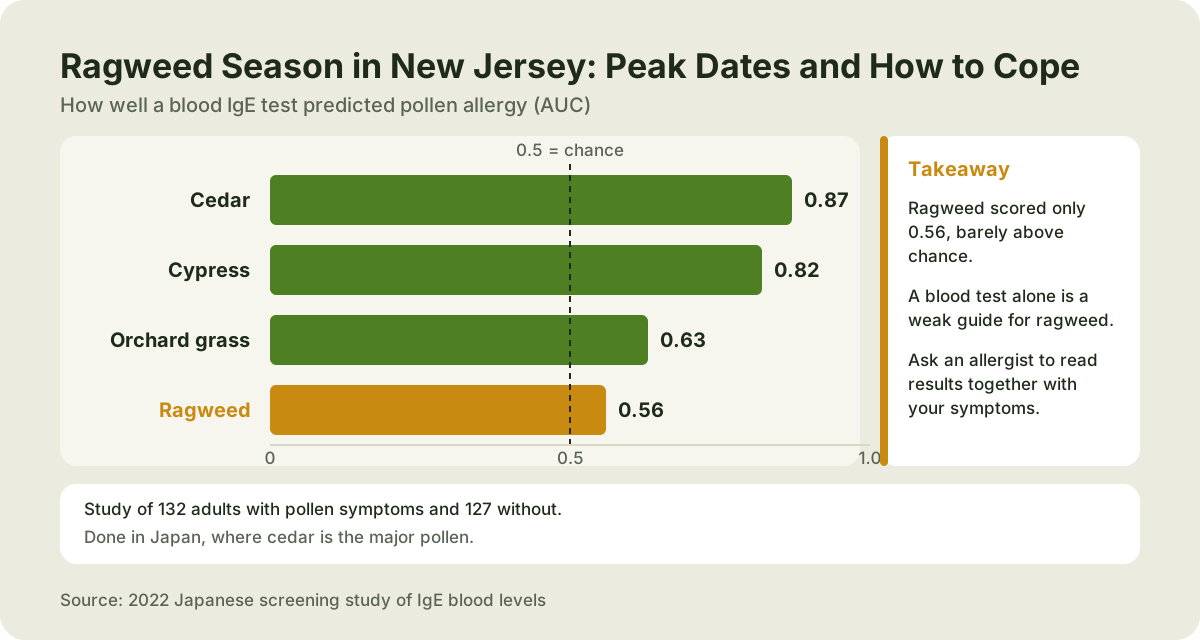
- A Japanese screening study found a blood test for ragweed IgE was a weak predictor of ragweed allergy (area under the curve 0.56, where 0.5 is chance), so testing is best interpreted by an allergist.
- Ragweed has two long-term options that a doctor can offer: a daily under-the-tongue tablet or allergy shots, and trials of the tablet showed meaningful benefit for seasonal symptoms.
Ragweed is the main cause of fall hay fever in New Jersey. It grows along roadsides, in vacant lots and at the edges of farms and suburban yards, and its light pollen travels on the wind. This guide covers when the season peaks, what helps day to day, and when to get medical help.
When is ragweed season in New Jersey?
Ragweed season in New Jersey typically starts in mid-August, peaks in September, and tapers off in October. A hard frost usually ends it. Exact dates change with the weather each year, so treat these as a general pattern and not a forecast.
The season matters because it overlaps with back-to-school time. Kids and teens often notice symptoms in the first weeks of September and assume they have a cold. A "cold" that shows up every year at the same time, with itchy eyes and clear mucus, is more likely ragweed.
One study looked at Google searches for "ragweed" from 2011 to early 2017 across 15 countries with known ragweed seasons. The word "ragweed" was clearly identified in 12 of the 15. The authors suggested that search patterns may reflect real-life allergy seasons. The study did not measure pollen or symptoms directly, and the results varied a lot between countries. It is a hint about when people feel allergic, not a pollen count.
What are the signs of a ragweed allergy?
The usual signs are sneezing, a runny or stuffy nose, itchy eyes, and itching in the nose or throat that lasts for weeks in late summer and fall. Some people also get postnasal drip, a cough, or tiredness. Fever and thick yellow-green mucus are not typical of allergy.
Three clues point to ragweed over a cold:
- Symptoms start around mid-August and return each year.
- Eyes and nose itch, not just ache.
- Symptoms last more than 10 days with no fever.
People with asthma may find it harder to breathe during the season. That is a reason to check in with a doctor, covered below.
How can you get through ragweed season at home?
The goal is to cut the amount of pollen that reaches your nose and eyes. Small habits add up over a six-to-eight-week season.
Keep pollen out of the house
- Keep windows closed on dry, windy days, especially in the morning and around midday when pollen is often highest.
- Run the air conditioner on recirculate in the car and at home. Change the filter on schedule.
- Shower and wash your hair before bed so pollen does not end up on your pillow.
- Take shoes off at the door. Dry laundry in a dryer, not on an outdoor line.
- Wipe down pets that have been outside. Pollen rides in fur.
Shore towns can feel different from inland suburbs, but wind carries ragweed pollen long distances, so a beach house is not automatically a safe zone. Check local pollen reports and plan outdoor time with them in mind.
Rinse and moisturize
Saline rinses can wash pollen out of the nose. If you use one, follow the FDA's guidance on safe water for sinus rinsing: use distilled, sterile, or previously boiled and cooled water, never plain tap water. For more background, see what the studies show about nasal irrigation.
Allergy season can also leave the nose dry and sore. Antihistamines, decongestant sprays and heated indoor air as fall turns cold can all add to it. A nasal moisturizer such as Narisure can soothe and moisturize dry nasal passages, though it does not replace allergy medicine.
Use medicines on a schedule
Many people do better starting allergy medicine before symptoms peak, for example in early August. A pharmacist can explain the over-the-counter options, including nasal steroid sprays, oral antihistamines and eye drops. Read labels, and ask before combining products, especially for children.
Why does ragweed make some foods itch?
Some ragweed-allergic people get an itchy mouth or throat from certain raw fruits and vegetables. This is called oral allergy syndrome, or pollen-food allergy syndrome. The proteins in some foods look similar to pollen proteins, so the immune system reacts.
A 2018 review of oral allergy syndrome (OAS) found these key points:
- OAS was reported in about 5-8% of people with pollen allergy.
- About 1-2% of those with OAS had extreme reactions such as anaphylaxis.
- People with ragweed allergy may react to melon, cucumber, banana and zucchini.
- Symptoms usually start within moments of eating and fade a couple of minutes after swallowing.
- The raw food usually triggers symptoms, while the cooked version often does not.
The review summarized published literature, so it shows patterns, not what will happen to any one person. If a food ever causes swelling of the lips or tongue, trouble breathing, vomiting, or dizziness, treat it as an emergency and call 911.
How is a ragweed allergy confirmed?
An allergist usually combines your history with a skin-prick test or a blood test. History matters: the timing of symptoms is a strong clue.
Be careful with blood tests alone. A 2022 study in Japan compared 132 adults with pollen symptoms against 127 without. It measured how well IgE blood levels predicted pollen allergy. The area under the curve was 0.87 for cedar, 0.82 for cypress, 0.63 for orchard grass and just 0.56 for ragweed. A score of 0.5 is chance, so ragweed's result was weak. The authors also found that cross-reactive carbohydrate components could cause false positives.
This study was in a Japanese population, where cedar is the major pollen, and it was a screening test, not a full workup. Still, it shows why a test result should be read by a specialist along with your symptoms.
What long-term options exist for ragweed allergy?
People whose symptoms are hard to control can ask an allergist about immunotherapy, which gradually trains the immune system to tolerate an allergen. There are two main forms.
| Option | How it works | What a review found |
|---|---|---|
| Ragweed sublingual tablet | A tablet dissolves under the tongue | A review by Johns Hopkins–affiliated and German authors described pivotal trials showing statistically significant, clinically meaningful benefit for ragweed seasonal rhinitis-conjunctivitis, with or without milder asthma |
| Allergy shots (subcutaneous) | Injections of allergen extract at the doctor's office | A review of dosing studies found an effective dose is likely 5-20 µg of major allergen per injection, and maintenance shots are commonly given 1-2 times per month |
Both need a doctor's evaluation, and both require months of commitment. The tablet is taken at home after a first supervised dose, while shots are given in a medical setting. Reviews summarize the research; they do not predict your own result. Starting treatment usually happens well before the season, so fall is a good time to ask for a plan for next year.
When should you see a doctor?
See a doctor if symptoms last more than a few weeks, if over-the-counter medicine is not enough, or if allergy is disturbing sleep, school or work. Get care promptly for these:
- Wheezing, chest tightness or shortness of breath
- Facial pain or pressure with thick discolored mucus and fever, or symptoms lasting more than 10 days without improving
- Frequent nosebleeds or a nose that stays painfully dry
- Itchy mouth with any lip, tongue or throat swelling after eating (call 911 for breathing trouble)
For background reading, see MedlinePlus on hay fever. If you want testing or a long-term plan before next August, you can find allergy and sinus doctors in New Jersey who see ragweed season every year.
Common questions
When does ragweed pollen peak in New Jersey?
Ragweed pollen in New Jersey typically starts in mid-August and peaks in September. It then fades through October, usually ending after the first hard frost. Timing changes with each year's weather, so local pollen reports are a better guide for any given week than a fixed date.
Why does my mouth itch when I eat melon or bananas during ragweed season?
This may be oral allergy syndrome. Some raw fruits and vegetables contain proteins similar to ragweed pollen. A 2018 review lists melon, cucumber, banana and zucchini as possible triggers for ragweed allergy. Cooking the food often removes the reaction. Swelling or trouble breathing needs emergency care.
Can a blood test tell me if I am allergic to ragweed?
A blood test can be one piece of the picture, but it is not enough alone. In a 2022 Japanese study, the ragweed IgE blood test had an area under the curve of just 0.56, close to chance. An allergist combines test results with your symptom history and skin testing.
Do allergy tablets or shots work for ragweed?
A review of pivotal trials found the ragweed under-the-tongue tablet gave meaningful benefit for seasonal rhinitis and eye symptoms. Allergy shots are another option, with doses of about 5-20 µg of major allergen per injection. Both need an allergist's evaluation and several months of use.
Sources
- Oral allergy syndrome. American journal of rhinology & allergy, 2018
- Ragweed sublingual tablet immunotherapy: part I - evidence-based clinical efficacy and safety. Immunotherapy, 2018
- Differences in Reporting the Ragweed Pollen Season Using Google Trends across 15 Countries. International archives of allergy and immunology, 2018
- Evidence-based dosing of maintenance subcutaneous immunotherapy: a contemporary review of state-of-the-art practice. International forum of allergy & rhinology, 2018
- Pollen Allergy Screening with Allergen-Specific and Total Immunoglobulin E Titers. Allergy & rhinology (Providence, R.I.), 2022
Trusted resources
From our sister sites
Healthy NosesWhy One Nostril Is Always Blocked: The Nasal Cycle ExplainedOne blocked nostril is usually the nasal cycle, a normal switch of swelling between sides. Learn why it happens, what's normal, and when to see a doctor.Coastal SinusHow Long Does a Sinus Infection Last? When to WorryMost sinus infections clear up on their own in 7 to 10 days. Get the full timeline, warning signs of a bacterial infection, and when to call a doctor.Articles are for general information, not medical advice. See a doctor for symptoms that are severe, last more than 10 days, or keep coming back. Last updated November 4, 2026.