Longer Pollen Seasons in the US: What the Research Shows
Research suggests US pollen seasons may grow longer and heavier with warming. See what three studies found and what they can't tell NJ allergy sufferers.
The short version
- A 2022 computer simulation of the continental US found that with 4-6 K of end-of-century warming, spring pollen emissions could start 10-40 days earlier and total yearly emissions could rise 16-40%.
- A 2025 scoping review of 30 studies found 16 that reported longer pollen seasons or higher pollen concentrations linked to climate change.
- A small Michigan study of 49 allergy-shot patients linked high ragweed pollen to sleepiness two days later, but not to nose or asthma symptoms.
- Most of this evidence is projection or from small groups, so it shows a direction of change, not an exact forecast for any New Jersey town.
Pollen seasons are often described as getting longer, but how strong is the evidence? Three recent studies look at the question in different ways: a computer simulation of the whole continental US, a review of 30 published studies, and a small study of allergy patients in Michigan. Each one adds a piece, and each one has limits.
Are pollen seasons getting longer in the United States?
Most of the research points that way, but much of it is projection rather than direct measurement. A 2025 review found that 16 of 30 included studies reported longer pollen seasons and/or higher pollen concentrations tied to climate change. That is a consistent signal, though not a precise count of days for any one place.
The sections below explain how each study was done, so the numbers can be read in context.
What did the Nature Communications simulation find?
The 2022 study by Zhang and Steiner (University of Michigan) used a pollen emission model and future climate data to project how pollen release could change across the continental US. It found that warming of 4-6 K by the end of the century could shift the start of spring pollen emissions 10-40 days earlier and the season length would grow.
How the study was done
This was a simulation, not a pollen count taken from the air. The researchers fed projected temperature and rainfall into a model of how plants release pollen. They also tested what happens when atmospheric CO2 rises and when land cover changes.
What it found
- Spring pollen (mostly trees): emissions started 10-40 days earlier.
- Summer and fall pollen (weeds and grasses): the season shifted 5-15 days later. Ragweed belongs to this weed group.
- Daily peaks: temperature and rainfall changed the highest daily emission by -35 to +40%, so some days and places could get lighter, not just heavier.
- Yearly total: annual pollen emission rose 16-40% because of changes in timing and temperature-driven pollen production.
- CO2: if higher CO2 also doubles how much pollen plants make, end-of-century emissions could rise by up to 200%.
- Land cover: changes in where plants grow mattered much less (under 10%) than climate or CO2.
The authors also noted that different plant types respond differently to temperature. In some regions the seasons of different plants move closer together, and in others they move apart.
What it cannot tell us
The study models pollen released by plants. It does not measure how much pollen people breathe or how many people get symptoms. The results also depend on the warming and CO2 assumptions that were put in. The authors conclude that more pollen and longer seasons would raise the likelihood of seasonal allergies, which is a reasonable inference, not a measured outcome.
What does the 2025 scoping review add?
The review in The Laryngoscope adds breadth. It searched four databases for English-language studies published from 2000 to 2023. Of 502 articles assessed, 30 met the criteria.
Key results:
- Sixteen studies reported longer pollen seasons and/or higher pollen concentrations related to climate change.
- Two studies projected total pollen emissions to rise 16-40% and pollen season length to grow by 19 days in North America.
- Four studies reported more allergic rhinitis-related healthcare use. Low-income residents were affected most.
- Two studies found that healthcare professionals want more education about climate change.
The 16-40% range matches the figure in the simulation above, so some of the review's projections may overlap with that work rather than being fully independent.
What it cannot tell us
A scoping review maps what research exists. It does not combine results into one pooled estimate, and it is not designed to rank studies by quality. The studies it gathered also came from many regions and used different methods, so the 19-day figure is a North American projection, not a New Jersey forecast. The review's wording is also broad: it found that climate change is "altering" pollen seasons, concentrations and symptoms, which is a trend, not a single measured number.
What did the Michigan ragweed study find?
This 2024 study looked at what high pollen might do to people. It found that sleepiness peaked two days after intense ragweed exposure, but nose and asthma symptoms were not linked to ragweed counts in this small group.
How the study was done
The researchers followed 49 adults at a southeastern Michigan allergy clinic. All were getting immunotherapy (allergy shots) for pollen allergies. The mean age was 37.9 years, and 26 were women. Participants did an intake survey, then answered a short emailed survey every day for 21 days about sleepiness and asthma symptoms. Ragweed pollen levels came from a computer model that predicts counts on a grid of 25 km squares, matched to each person's date and location.
What it found
Sleepiness was highest two days after exposure (estimate 0.33, with a range of 0.04 to 0.62). Asthma and allergy symptoms were not associated with ragweed pollen in this sample.
What it cannot tell us
The group was small and had allergies severe enough for immunotherapy, which is not typical of all allergy sufferers. Pollen levels were model predictions for a 25 km area, not what each person breathed, and participants traveled widely during the study. The lower end of the range (0.04) sits close to zero, so the result is fragile. The study did not test whether seasons were longer, only whether high exposure days were linked to sleepiness.
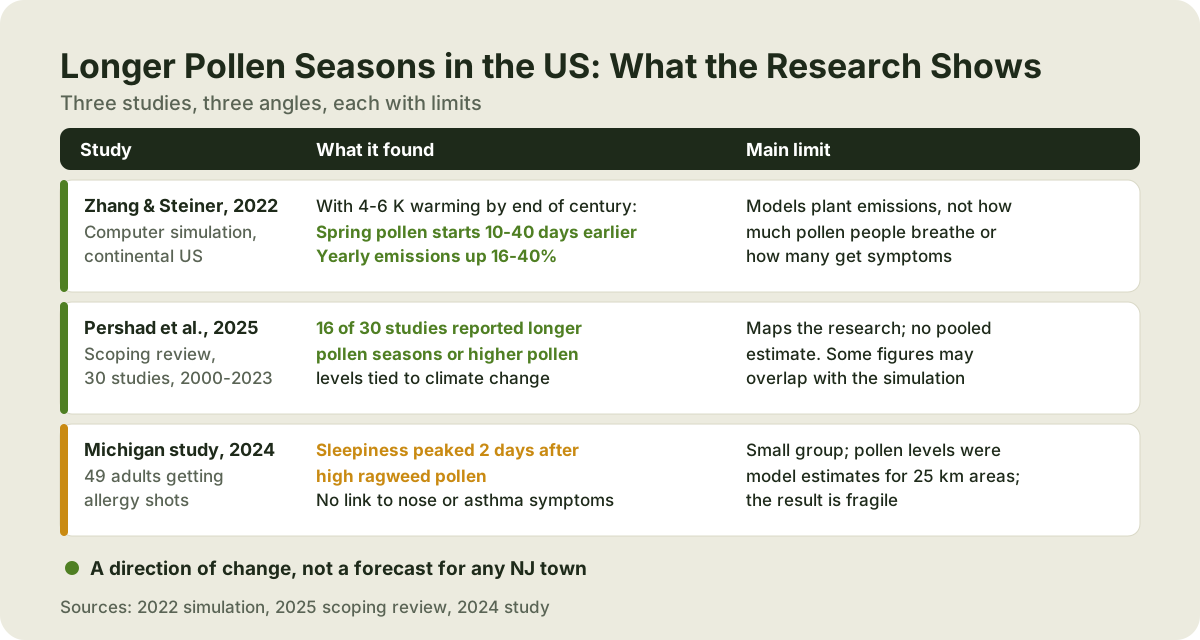
How do the three studies compare?
| Study | Design | Scope | Main result | Main limit |
|---|---|---|---|---|
| Zhang & Steiner, 2022 | Pollen emission simulation | Continental US, end of century | Spring starts 10-40 days earlier; yearly emissions up 16-40% | Models plant emissions, not human exposure |
| Pershad et al., 2025 | Scoping review | 30 studies, 2000-2023 | 16 reported longer seasons or higher pollen | Does not pool or grade results; mixed regions |
| Larson et al., 2024 | Daily surveys plus modeled pollen | 49 immunotherapy patients, Michigan | Sleepiness peaked 2 days after ragweed exposure | Small, specific group; 25 km modeled pollen |
What does this mean for New Jersey readers?
The research suggests the pollen calendar may stretch at both ends. In New Jersey, that would mean tree pollen could begin earlier in spring, and weed pollen such as ragweed could linger later into fall. The simulation's 10-40 day and 5-15 day shifts are projections for the end of the century under strong warming, not measurements for New Jersey today.
Practical steps do not depend on exact forecasts:
- Track symptoms for a few seasons. Note the dates they start and stop.
- Check local daily pollen reports instead of relying on last year's calendar.
- Keep windows closed on high-pollen days and shower after long time outdoors.
- Do not assume that fatigue in allergy season is only from poor sleep. The Michigan study hints at a link, but it is only one small study.
For ragweed timing specifics, see the site's existing guide to New Jersey's ragweed season.
What can't this research tell us?
Three things stand out. First, projections are not predictions: they depend on how much the climate warms and whether CO2 changes plant pollen output. Second, none of the three studies measured pollen at a New Jersey backyard. Third, more pollen does not automatically mean more symptoms for every person. Sensitivity, indoor air, medicines and time outdoors all matter.
When should you see a doctor?
A longer season can mean a longer stretch of symptoms, and that is worth sorting out with a professional. Consider an appointment if:
- Sneezing, congestion or itchy eyes last more than a few weeks or return every year.
- Over-the-counter options are not giving enough relief.
- Symptoms disturb sleep or cause heavy daytime tiredness.
- Wheezing, chest tightness or shortness of breath appear.
- Congestion with facial pain or thick discolored mucus lasts more than 10 days, or comes with a high fever.
Seek urgent care for trouble breathing, swelling of the face or throat, or a sudden severe reaction. Testing can show which pollens trigger symptoms, which helps match the plan to the season. New Jersey readers can find nearby specialists through this list of allergy and sinus doctors in New Jersey.
Common questions
Is pollen season really getting longer?
Many studies say yes. A 2025 scoping review found 16 of 30 included studies reported longer pollen seasons or higher pollen concentrations linked to climate change. Much of the numeric evidence is projection, though, so it shows a direction of change rather than an exact number of days for any town.
How much longer could pollen seasons get in North America?
One projection cited in a 2025 review put the increase at 19 days in North America, with total pollen emissions rising 16-40%. A 2022 simulation found spring emissions starting 10-40 days earlier by end of century under 4-6 K warming. These are model results, not measurements.
Does more pollen mean worse allergy symptoms?
Not always. The simulation authors say more pollen and longer seasons raise the likelihood of seasonal allergies, but symptoms depend on each person's sensitivity. In a small Michigan study of 49 allergy-shot patients, ragweed levels were not linked to asthma or allergy symptoms, though sleepiness rose two days later.
Can ragweed pollen make you sleepy?
One small study suggests it might. Among 49 immunotherapy patients in Michigan, sleepiness peaked two days after intense ragweed exposure. The group was small, pollen levels were modeled for 25 km areas, and the result was borderline, so it needs confirmation in larger studies.
Sources
- How Climate Change Is Impacting Allergic Rhinitis: A Scoping Review. The Laryngoscope, 2025
- Projected climate-driven changes in pollen emission season length and magnitude over the continental United States. Nature communications, 2022
- Pollen effects in a changing climate: Ragweed pollen exposure and sleepiness in immunotherapy patients of a Southeastern Michigan allergy clinic. International journal of biometeorology, 2024
Trusted resources
From our sister sites
Healthy NosesIndoor Humidity and Respiratory Infections: What New Research ShowsDry indoor air may let virus droplets linger and slow nasal mucus clearing. Here is what three recent studies found, and what they cannot prove.Coastal SinusSaline Irrigation for Chronic Sinusitis: What the Trials FoundCochrane reviews of saline irrigation for chronic sinusitis found only two small trials. Here is what they showed, and what they cannot tell us.Articles are for general information, not medical advice. See a doctor for symptoms that are severe, last more than 10 days, or keep coming back. Last updated November 5, 2026.