Antihistamines and a Dry Nose: Why Allergy Pills Dry You Out
Antihistamines can dry a runny nose, and older ones do it more. Learn why allergy pills leave you dry, what the studies show, and how to ease it.

The short version
- Antihistamines work partly by drying up runny-nose fluid, so some dryness is a side effect of the way they work.
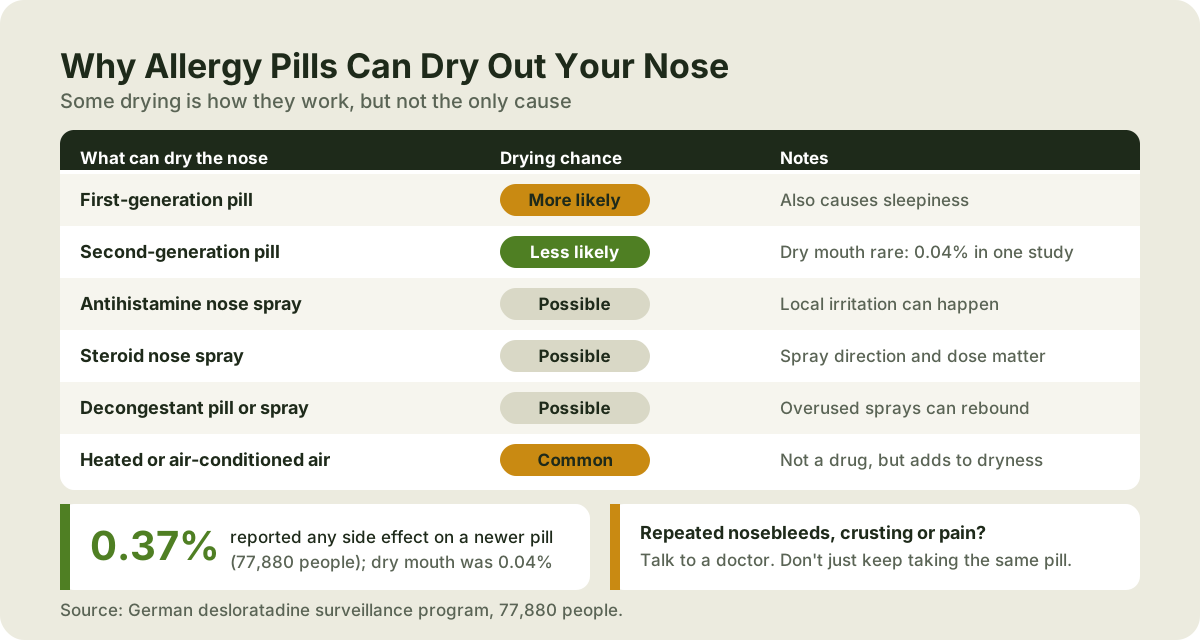
- In a German surveillance program of 77,880 people taking desloratadine, only 0.37% reported side effects, and dry mouth was reported by just 0.04%.
- Nasal sprays, decongestants and heated indoor air can dry the nose too, so the pill may not be the only cause.
- Dryness that brings repeated nosebleeds, crusting or pain is a reason to talk to a doctor, not just keep taking the same medicine.
Many people start an allergy pill to stop a runny nose and end up with a nose that is dry, crusty or sore. That is not in your head. Some drying is part of how these medicines work, and the rest of the story depends on which drug you take and what else is drying your nose.
Do antihistamines really dry out your nose?
Yes, they can. Antihistamines block histamine, a chemical that makes the nose leak fluid, itch and sneeze. Less fluid means less drip, but it can also mean a drier nose.
How much drying you notice varies a lot from person to person. Older antihistamines, like diphenhydramine (Benadryl) and chlorpheniramine, are well known for drying the mouth and nose. They also cause sleepiness. Newer ones, like loratadine, cetirizine, fexofenadine and desloratadine, are called second-generation. They are less sedating and are generally considered less drying.
Why does an allergy pill dry you out?
Allergic rhinitis, or hay fever, makes the nose produce a lot of thin mucus. An antihistamine turns that down. Older antihistamines also block other signals in the body, called anticholinergic effects. Those signals help control saliva and mucus, so blocking them dries the mouth, throat and nose.
This kind of drying is not unique to allergy drugs. A Cochrane review of scopolamine, a motion sickness drug, covered 14 trials with 1,025 people. It was not about allergies. It noted dry mouth as a side effect that was more likely with scopolamine than with at least one comparison drug. The review also said the studies were generally small and of varying quality. The takeaway is limited: several drug types can dry the mouth, and the review says nothing about nasal dryness from allergy pills.
How common is dryness with newer antihistamines?
It looks uncommon with second-generation pills, based on one large real-world program. German researchers followed 77,880 people aged 12 and older who took desloratadine 5 mg once a day for hay fever or chronic hives. The average treatment length was up to 40.4 days.
Here is what they found:
- 287 people (0.37%) reported a side effect.
- The most common were fatigue (0.07%), headache (0.07%), dry mouth (0.04%) and nausea (0.03%).
- About 99% of doctors and 98.5% of patients rated tolerability as excellent or good.
This study has limits. There was no placebo group and no comparison to other drugs, so it cannot show that desloratadine dries less than other pills. Side effects were reported, not measured with a nasal exam. The summary does not list nasal dryness separately. It also covers only one drug, in one country, in 2001 to 2002. It shows that dryness was rarely reported with this newer pill. It does not show that a dry nose never happens.
Can allergy nose sprays dry you out too?
Yes. Sprays can irritate or dry the lining of the nose, especially with daily use. Many people who blame their pill are also using a spray.
One trial looked at two antihistamine nose sprays, olopatadine 0.6% and azelastine 0.1%. Each was used along with fluticasone, a steroid nose spray, for 14 days. It was a randomized, double-blind study in people 12 and older with seasonal allergies. Both combinations improved nasal symptom scores, with no significant difference between them. No serious side effects occurred. There were 19 side effects in the olopatadine group and 29 in the azelastine group. The summary does not break out nasal dryness, so it cannot tell you how often sprays dry the nose. It is useful for one reason: using more than one nasal product at once is common, and each one is another possible source of irritation.
Here is how the usual suspects compare:
| Product | Drying effect | Notes |
|---|---|---|
| First-generation pill (diphenhydramine, chlorpheniramine) | More likely | Also causes sleepiness |
| Second-generation pill (loratadine, cetirizine, fexofenadine, desloratadine) | Less likely | Dry mouth was rare in the desloratadine study |
| Antihistamine nose spray | Possible | Local irritation can happen |
| Steroid nose spray | Possible | Spray direction and dose matter |
| Decongestant pill or spray | Possible | Sprays can cause rebound congestion if overused |
| Heated or air-conditioned indoor air | Common | Not a drug, but it adds to dryness |
Is it the pill, or is it the air?
It can be both. Many New Jersey homes run forced-air or radiator heat for months, and indoor air gets very dry. In summer, air conditioning near the shore or in the suburbs can dry the nose as well. Add a daily allergy pill, and the effects stack.
A simple test: note when the dryness is worst. If it is bad indoors in winter and better outdoors, the air is likely a big factor. If it started within days of a new medicine, the medicine is a suspect. Do not stop a prescribed medicine without asking the prescriber.
What helps a dry nose while you still need allergy relief?
Start with the basics. They are low-risk and often enough.
- Ask about switching pills. If you take an older antihistamine, a second-generation one may dry you less. Ask a pharmacist or doctor.
- Take the lowest dose that works. Follow the label. More is not better.
- Drink water and use a humidifier. Keep indoor humidity comfortable and clean the humidifier as directed. Our guide on why your nose gets so dry in winter covers heated-air dryness in more detail.
- Use saline. Saline spray or gel can add moisture. If you rinse, use distilled, sterile or boiled-and-cooled water, as the FDA advises.
- Try a nasal moisturizer. Narisure is a nasal moisturizer that soothes and moisturizes dry nasal passages.
- Do not pick or rub. Dry skin inside the nose cracks easily.
If a nosebleed starts, sit up and lean slightly forward. Pinch the soft part of the nose firmly for 10 minutes without letting go to check. Do not tilt your head back.
When should you see a doctor about a dry nose from allergy medicine?
See a doctor if dryness does not improve after a week or two of simple steps. Also go if you get nosebleeds more than once in a while, or if crusting or sores keep returning. Other warning signs are pain inside the nose, one-sided bleeding or blockage, and thick yellow-green mucus with fever or facial pain lasting more than 10 days.
Get help right away if a nosebleed lasts longer than 20 minutes despite pressure, or follows a head injury. Talk to a doctor or pharmacist before using drying antihistamines if you have glaucoma, trouble urinating, or are older, since older antihistamines can cause confusion in some people. Do not use decongestant sprays for more than a few days unless a clinician tells you to. For a proper exam and a medicine plan that fits you, you can find allergy and sinus doctors in New Jersey who see this problem often.
Common questions
Why do antihistamines make my nose dry?
Antihistamines reduce the thin mucus and fluid that allergies cause, so a drier nose can follow. Older ones such as diphenhydramine also block other body signals that control mucus and saliva, which adds to the dryness. Newer pills tend to dry less, but some people still notice it.
Which allergy pills dry you out the least?
Second-generation antihistamines such as loratadine, cetirizine, fexofenadine and desloratadine are generally less drying and less sleepy than older ones. In a surveillance program of 77,880 people on desloratadine, dry mouth was reported by only 0.04%. That study had no comparison group, so it cannot rank the pills.
Can allergy medicine cause nosebleeds?
Dryness from pills, sprays or heated air can crack the thin lining inside the nose and lead to minor nosebleeds. Most are brief. Lean forward and pinch the soft part of the nose for 10 minutes. See a doctor if bleeding is frequent or lasts over 20 minutes.
Should I stop my antihistamine if my nose is dry?
Do not stop a prescribed medicine without checking first. For over-the-counter pills, ask a pharmacist or doctor about a less drying type or a lower dose. Meanwhile, add moisture with saline, a humidifier and water. Stopping suddenly can bring back allergy symptoms.
Sources
- Safety and efficacy of desloratadine in subjects with seasonal allergic rhinitis or chronic urticaria: results of four postmarketing surveillance studies. Clinical drug investigation, 2010
- Scopolamine (hyoscine) for preventing and treating motion sickness. The Cochrane database of systematic reviews, 2011
- Evaluation of olopatadine hydrochloride nasal spray, 0.6%, used in combination with an intranasal corticosteroid in seasonal allergic rhinitis. Allergy and asthma proceedings, 2010
Trusted resources
From our sister sites
Healthy NosesNasal Irrigation for Sinus Symptoms: What the Studies ShowNasal saline irrigation may ease allergy and sinus symptoms, but the evidence is small and low quality. Here is what three studies found, and their limits.Coastal SinusSummer Humidity, Mold and Sinus Flare-Ups at the ShoreHumid shore summers can feed indoor mold that irritates the nose and sinuses. Learn the signs, what studies show, and how to cut damp at home.Articles are for general information, not medical advice. See a doctor for symptoms that are severe, last more than 10 days, or keep coming back. Last updated November 11, 2026.