Spring Tree Pollen in NJ: Oak, Birch and Maple Allergy Guide
Oak, birch and maple pollen hit New Jersey in spring. Learn timing, symptoms, cross-reactions, ways to cut exposure and when to see a doctor.
The short version
- Oak, birch and maple trees release pollen at slightly different times, so tree allergy symptoms can last for weeks instead of days.
- Birch, oak, beech, hazel, alder and chestnut share similar allergy proteins, so a person allergic to birch often reacts to oak too (European review, 2019).
- Many people with birch allergy also react to some raw fruits and vegetables, a problem called pollen food syndrome.
- In a Korean study of 14,678 schoolchildren, trees were the most common pollen type that children tested positive for (25.2%), and rates differed by region.
Every spring, New Jersey's oaks, birches and maples shed huge amounts of fine yellow pollen. For people with tree allergies, that means itchy eyes, sneezing and a stuffy nose that can drag on for weeks. This guide explains when it happens, which trees matter, and what actually helps.
When is tree pollen season in New Jersey?
Tree pollen season in New Jersey usually starts in late winter or early spring and runs into late spring. The exact dates move from year to year with the weather. A warm March can start the season early. A cold, wet April can delay it.
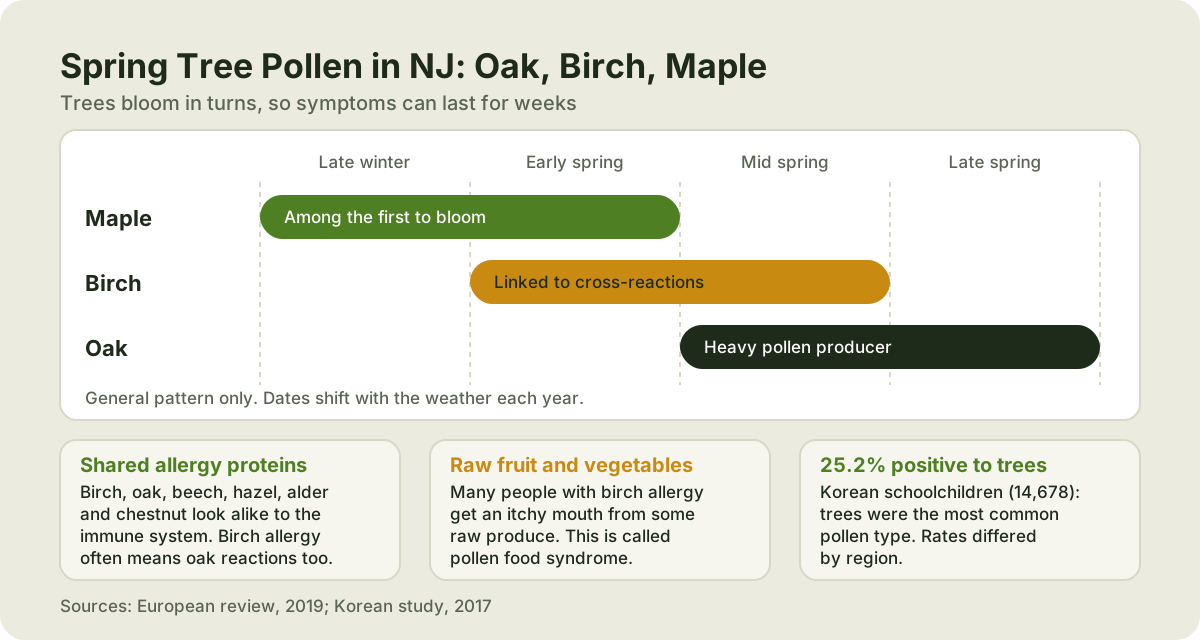
Different trees take turns. The rough pattern looks like this:
| Tree | Typical timing in NJ (varies by year) | Good to know |
|---|---|---|
| Maple | Late winter to early spring | Among the first trees to bloom. Common on streets and in yards. |
| Birch | Early to mid spring | Strongly linked to cross-reactions with other trees and foods. |
| Oak | Mid to late spring | Heavy pollen producer. Closely related to birch in allergy terms. |
The timing column is a general pattern, not a measurement. For real numbers on a given day, check a local pollen count from a certified counting station or a weather service.
A European review of birch allergy (Biedermann and colleagues, 2019) points out why this matters. Related trees pollinate in sequence. That creates a longer stretch of symptoms than birch alone would cause. The same logic fits New Jersey, where several tree types bloom one after another.
Which is worse: oak, birch or maple pollen?
There is no single answer, because it depends on which tree your immune system reacts to. Allergy testing is the only way to know. The research supplied for this guide covers oak and birch well. It does not cover maple, so maple claims here stay general.
What the research shows:
- Birch is the dominant tree pollen in Northern and Central Europe and a major cause of allergic rhinitis (hay fever), according to the 2019 European review.
- Oak pollen allergy is common worldwide, according to a 2022 review by Jeong and Park. The review describes oak and birch as highly cross-reactive.
- Korea has a similar picture. A 2021 review by the same authors says oak and birch pollen in spring are among the main causes of seasonal allergic rhinitis there. Ragweed and other weeds add to it later.
Two limits matter. These are narrative reviews, not trials. They also describe Europe and Korea, where tree species and climate differ from New Jersey. The Korean work, for example, focuses on the sawtooth oak, a species that differs from the oaks common in the eastern US.
Why does birch allergy make oak (and other trees) bother me too?
Birch, oak and several other trees carry very similar allergy proteins. The immune system can mistake one for another. This is called cross-reactivity.
The 2019 European review groups birch with alder, hazel, oak, hornbeam, chestnut and beech. It calls this the birch homologous group. The grouping rests on shared IgE cross-reactivity to a major birch allergen called Bet v 1. IgE is the antibody involved in allergic reactions.
In plain terms:
- Your body learns to react to birch pollen.
- Oak pollen looks similar to it.
- Your body reacts to oak too, even if you were never tested for oak.
The 2022 oak review makes the same point. It suggests oak allergy may get less study because it overlaps so much with birch.
Can tree pollen allergy cause reactions to food?
Yes. Many people with birch allergy get an itchy mouth or throat after eating certain raw fruits, vegetables or nuts. This is called pollen food syndrome, or oral allergy syndrome.
The reason is again shared proteins. The 2019 review notes that many plant foods contain relatives of Bet v 1. It reports that the majority of birch-allergic patients develop pollen food syndrome. The 2022 oak review says allergy to oak together with birch often causes pollen food syndrome to fruits and vegetables.
Common signs include:
- Itching or tingling in the mouth or lips
- Mild swelling of the lips or tongue
- Symptoms that start within minutes of eating raw produce
Cooking often changes these proteins, so cooked versions may cause fewer problems. That is general allergy guidance, not a result from these studies. Any swelling of the throat, trouble breathing, or widespread hives after eating needs emergency care.
How do I know it is tree pollen and not a cold?
Allergies and colds feel alike, but a few clues separate them.
| Clue | Tree pollen allergy | Cold |
|---|---|---|
| Itchy eyes, nose or throat | Common | Less common |
| Mucus | Thin and clear | Often thicker, may turn yellow |
| Fever or body aches | No | Possible |
| Length | Weeks, tied to bloom season | Usually 7 to 10 days |
| Pattern | Worse outside or on windy, dry days | Not tied to weather |
If symptoms return in the same weeks every spring, tree pollen is a strong suspect. A doctor can confirm it with a skin prick test or a blood test.
Testing has real value. A Korean study of 14,678 schoolchildren, published in 2017, used questionnaires and skin prick tests in five provinces. Tree pollen was the most common pollen sensitization (25.2%). Rates for birch, oak, alder and elm differed from one region to another. The study was in Korean children, so the numbers do not transfer to New Jersey. The lesson does: where you live shapes which pollens affect you, and testing shows which ones are yours.
What helps with spring tree pollen allergies?
The goal is to lower how much pollen reaches your nose and eyes, and to treat symptoms early. These steps are general, well-established guidance.
Cut your exposure
- Check the daily pollen count and plan outdoor time for lower-count days.
- Keep windows closed on dry, windy days. Run the air conditioning on recirculate in the car.
- Shower and wash your hair before bed so pollen stays off your pillow.
- Change clothes after time outside. Dry laundry in a dryer instead of on an outdoor line.
- Wipe pets with a damp cloth after walks. Fur holds pollen.
- Wear sunglasses outdoors to shield your eyes.
Start medicine early
Over-the-counter antihistamines and steroid nasal sprays usually work best when started before symptoms peak. Many allergists suggest beginning one to two weeks before your usual season starts. Ask a pharmacist or doctor which option suits you.
Rinse and moisturize
Saline rinses can wash pollen out of the nose. Use distilled, boiled-and-cooled or sterile water only. The Healthy Noses guide to safe nasal saline rinses covers the steps.
Some people also notice a dry, irritated nose from antihistamines, decongestant sprays or heated indoor air in early spring. Narisure is a nasal moisturizer that soothes and moisturizes dry nasal passages. It is for comfort and is not a replacement for allergy medicine.
Ask about immunotherapy
Allergy shots or under-the-tongue tablets can retrain the immune system over several years. The 2022 oak review says that using specific allergen molecules is expected to improve diagnosis and the effectiveness of immunotherapy. That points to better testing in the future. It is not proof of results for any one person. An allergist can say whether it fits your case.
When should I see a doctor?
See a doctor if over-the-counter medicine does not control your symptoms after a couple of weeks, or if allergies disrupt sleep, school or work.
Book a visit sooner for any of these:
- Wheezing, chest tightness or shortness of breath
- Facial pain or pressure with thick, discolored mucus lasting more than 10 days
- Fever along with nasal symptoms
- Symptoms that return every spring and keep getting worse
- Mouth or throat itching after eating raw fruits or vegetables
Call 911 for swelling of the throat or tongue, trouble breathing, or fainting after eating or any exposure.
To get tested and build a plan before next season, see allergy and sinus doctors in New Jersey.
Common questions
What month is tree pollen worst in New Jersey?
Tree pollen is usually heaviest in spring, often from April into May, though the exact timing changes each year with the weather. Maple tends to start first, then birch, then oak. Check a local daily pollen count for real numbers instead of relying on calendar dates.
If I am allergic to birch, will I react to oak?
Often, yes. Birch, oak, beech, hazel, alder, hornbeam and chestnut share similar allergy proteins, so the immune system can react to all of them. A 2019 European review describes this as cross-reactivity. An allergy test can show which trees affect you.
Why does my mouth itch when I eat raw apples in spring?
This may be pollen food syndrome. Some raw fruits and vegetables contain proteins similar to birch pollen allergens, so the mouth reacts. A 2019 review found most birch-allergic patients develop it. Cooking often reduces the reaction. Throat swelling or trouble breathing is an emergency.
How can I tell tree pollen allergy from a spring cold?
Allergies bring itchy eyes and nose, thin clear mucus and no fever, and last weeks during bloom season. Colds often cause thicker mucus, body aches or a low fever, and usually clear in 7 to 10 days. Symptoms that repeat each spring point to allergy.
Sources
- Allergens of Regional Importance in Korea. Frontiers in allergy, 2021
- Birch pollen allergy in Europe. Allergy, 2019
- Oak Pollen Allergy in Korea. Current protein & peptide science, 2022
- Regional Difference of Causative Pollen in Children with Allergic Rhinitis. Journal of Korean medical science, 2017
Trusted resources
From our sister sites
Healthy NosesRhinitis Sicca: What a Chronically Dry Nose MeansRhinitis sicca is a long-lasting dry nose, from mild dryness to crusting. Learn the causes, how it differs from atrophic rhinitis, and when to see a doctor.Coastal SinusSummer Humidity, Mold and Sinus Flare-Ups at the ShoreHumid shore summers can feed indoor mold that irritates the nose and sinuses. Learn the signs, what studies show, and how to cut damp at home.Articles are for general information, not medical advice. See a doctor for symptoms that are severe, last more than 10 days, or keep coming back. Last updated November 9, 2026.