Do HEPA Air Purifiers Help Allergies? What Trials Found
HEPA air purifiers may ease some allergy symptoms, but results are mixed. Here is what two trials and a Cochrane review found, and what they miss.

The short version
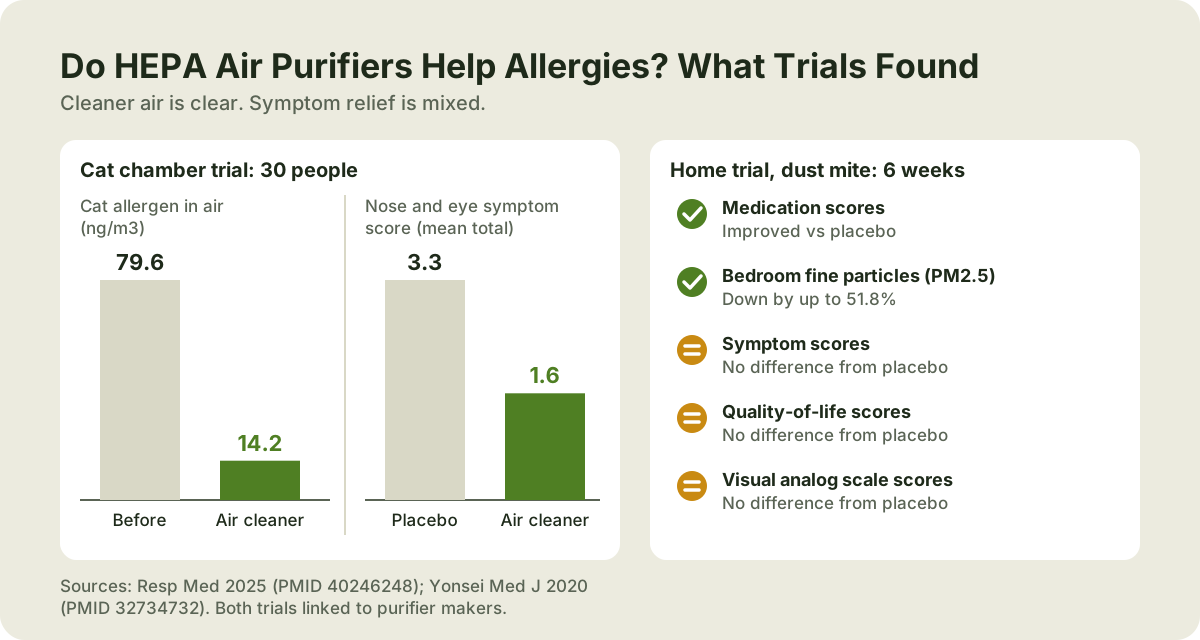
- In a 30-person chamber trial, a HEPA air cleaner cut cat allergen in the air from 79.6 to 14.2 ng/m3 and lowered nasal and eye symptom scores from 3.3 to 1.6.
- In a 6-week home trial of dust mite allergy, HEPA purifiers lowered medication scores and fine particle levels, but people's own symptom and quality-of-life scores did not differ from placebo.
- A Cochrane review of 9 dust mite avoidance trials (501 people) found the evidence small and low in quality, and two of those trials tested HEPA filters.
- Both purifier trials were run by teams linked to purifier makers or funded by one, so independent trials are still needed.
People with allergies often ask whether a HEPA air purifier is worth buying. Two randomized trials and one large review give a partial answer. The short version: purifiers clearly clean the air, but the proof that this makes allergy symptoms better is mixed.
Do HEPA air purifiers help allergy symptoms?
Sometimes, and mostly in small, short studies. In one trial, symptoms dropped. In another, symptoms people rated themselves did not change, but they used less allergy medicine. A purifier is best seen as one helper, not a stand-alone fix.
What is a HEPA filter, and what does it catch?
A HEPA filter is a dense mesh that traps tiny airborne particles. True HEPA filters are rated to catch at least 99.97% of particles about 0.3 microns wide. Pollen, pet dander and dust mite debris are mostly in that size range or larger.
The filter only works on air that passes through it. Allergen that has settled into carpet, bedding or sofas stays put until it is stirred up.
What did the cat allergy chamber trial find?
This trial tested whether a HEPA H13 air cleaner could reduce reactions to cat allergen in a controlled room. It was published in Respiratory Medicine in 2025 (PMID 40246248).
How it was done
- Who: 30 adults with mild cat-triggered asthma (GINA steps 1-2), with or without allergic rhinoconjunctivitis (itchy, runny nose and eyes).
- Design: Single-center, randomized, double-blind, parallel-group. Neither the patients nor the staff knew who had the active air cleaner and who had a placebo unit.
- Setting: An environmental exposure chamber in Strasbourg, France. Each person sat for 2 hours in air containing 80 ng/m3 of cat allergen.
- Steps: At a first chamber visit, people had to show an early asthma response. At a second exposure, the active or placebo air cleaner was running.
What it found
- Cat allergen in the air fell from 79.6 ng/m3 to 14.2 ng/m3 with the air cleaner.
- The early asthma response came later in the active group (p = 0.02). After 50 minutes, none of the active-group patients had one, compared with 53.3% in the placebo group.
- Lung function (FEV1) dropped in 40% of the active group's early responses versus 73.3% in the placebo group. That gap was not statistically significant (p = 0.06).
- Nose and eye symptoms fell by 52.2%. The mean total symptom score was 1.6 with the air cleaner and 3.3 with placebo (p = 0.03).
Limits
Only 30 people took part, and the study used one brand of air cleaner. The exposure lasted 2 hours in a chamber, not weeks in a real home. The study was funded by Dyson, which makes the device tested.
What did the home trial for dust mite allergy find?
This trial moved purifiers into real homes. It was a multicenter, randomized, double-blind, placebo-controlled study in Korea, published in the Yonsei Medical Journal in 2020 (PMID 32734732).
How it was done
Adults with allergic rhinitis caused by house dust mites were randomly given either working HEPA purifiers or mock-up units that looked real but did not clean the air. Two units ran in each home, one in the living room and one in the bedroom, for 6 weeks. The main goal was to see whether symptom scores and medication scores improved. Other goals included quality of life, a visual analog scale (a rating of how bad symptoms feel) and indoor particle levels.
What it found
- Medication scores improved significantly with working purifiers compared with placebo.
- Symptom scores, visual analog scale scores and quality-of-life scores did not differ between groups.
- Fine particles (PM2.5) in the bedroom dropped by up to 51.8%. PM2.5 in the living room and PM10 in both rooms also fell significantly.
Limits
The abstract does not report how many people took part, so the size of the study is unclear. Six weeks is short for an allergy that lasts all year. Particle counts are not the same as dust mite allergen counts, so a cleaner room by this measure does not prove less allergen exposure. Several authors worked for the air care division of an appliance maker, which makes purifiers.
What does the Cochrane review say about HEPA filters and dust mites?
It says the evidence is weak overall. The review (PMID 20614426) looked at ways to cut dust mite exposure for people with perennial allergic rhinitis. The last search was December 2009.
It found nine randomized trials with 501 participants in total. Only two trials, both on mite-proof bedding covers, were good quality. The other seven were small and of poor quality. Two of the nine trials tested HEPA filters, and others tested acaricides (mite-killing products) or bedding covers.
Seven of the nine trials showed less dust mite load with the measures tested. But the review said the trials as a whole were small and of poor methodological quality. It found that mite-proof bedding covers alone are unlikely to give a clinical benefit. No serious side effects were reported. The abstract does not break out results for the HEPA trials alone, so this review cannot say how well purifiers work on their own.
How do the three studies compare?
| Study | Design | Allergen | Main result | Main limit |
|---|---|---|---|---|
| Cat chamber trial (2025) | 30 people, randomized, double-blind | Cat | Allergen in air fell; nose and eye scores lower | Short chamber visits; maker-funded |
| Korean home trial (2020) | Randomized, double-blind, 6 weeks | Dust mite | Less medicine used; symptom scores unchanged | Authors linked to a purifier maker; short |
| Cochrane review (2010) | 9 trials, 501 people | Dust mite | Weak evidence overall | Small, low-quality trials |
What can these studies not tell us?
- Long-term results. None followed people for a full allergy season or year.
- Pollen. None tested tree, grass or ragweed pollen, which drive many New Jersey allergy seasons.
- Other brands and sizes. Results from one machine may not carry over to a cheaper or undersized one.
- Independence. Neither purifier trial was run free of links to a purifier maker.
- Everyday life. Open windows, pets on the couch and humid summers all change how a purifier performs.
How can a purifier fit into a New Jersey home?
The trials suggest purifiers are reasonable as an add-on, especially for cat or dust mite allergy. General advice from allergy specialists:
- Put the unit where the most time is spent, often the bedroom, and keep that door closed.
- Pick a size rated for the room. A small unit in a large living room will do little.
- Replace filters on the maker's schedule.
- Avoid devices that make ozone, which can irritate the airways.
- Pair it with other steps, such as washing bedding in hot water weekly and keeping pets out of the bedroom.
- Dust mites thrive in humid air, and NJ summers are humid. A dehumidifier or air conditioning that keeps indoor humidity under about 50% can help.
For general background on allergy triggers and symptoms, see the NIH's MedlinePlus pages on hay fever and allergy.
When should you see a doctor about allergy symptoms?
A purifier does not replace medical care. See a doctor if:
- Symptoms last more than a few weeks or keep coming back.
- Over-the-counter medicines are not enough.
- You have wheezing, chest tightness or shortness of breath. Seek urgent care if breathing is hard.
- Facial pain, thick colored discharge or fever last more than 10 days or get worse.
- Allergies disrupt sleep, school or work.
An allergist can test for the exact trigger, such as cat, dust mite or pollen, so any home changes are aimed at the right target. To find a specialist near you, see these allergy and sinus doctors in New Jersey.
Common questions
Do HEPA air purifiers really help with allergies?
They can help some people. In a 30-person chamber trial, a HEPA air cleaner cut cat allergen in the air and lowered nose and eye symptoms. In a home dust mite trial, medication use fell, but self-rated symptoms did not change. Evidence is mixed and studies are small.
Can a HEPA air purifier help with dust mite allergy?
Possibly. A 6-week home trial found people with dust mite rhinitis used less allergy medication with working HEPA purifiers than with placebo units. Symptom and quality-of-life scores did not differ. A Cochrane review called the overall dust mite trial evidence small and low in quality.
Do air purifiers remove cat allergen?
In a 2025 exposure chamber trial, a HEPA H13 air cleaner lowered airborne cat allergen from 79.6 to 14.2 ng/m3. That was a controlled room, not a real home, and the study was funded by the device maker. Allergen already settled on furniture is not removed.
Where should I put an air purifier for allergies?
The bedroom is a common choice because people spend hours there. The Korean home trial put units in both the bedroom and living room and found fine particles fell in both. Choose a unit sized for the room and keep doors closed while it runs.
Sources
- Efficacy of air cleaners to reduce allergic responses to cat: A randomized clinical trial using an environmental exposure chamber. Respiratory medicine, 2025
- House dust mite avoidance measures for perennial allergic rhinitis. The Cochrane database of systematic reviews, 2010
- Effects of Air Purifiers on Patients with Allergic Rhinitis: a Multicenter, Randomized, Double-Blind, and Placebo-Controlled Study. Yonsei medical journal, 2020
Trusted resources
From our sister sites
Healthy NosesNasal Irrigation for Sinus Symptoms: What the Studies ShowNasal saline irrigation may ease allergy and sinus symptoms, but the evidence is small and low quality. Here is what three studies found, and their limits.Coastal SinusSaline Irrigation for Chronic Sinusitis: What the Trials FoundCochrane reviews of saline irrigation for chronic sinusitis found only two small trials. Here is what they showed, and what they cannot tell us.Articles are for general information, not medical advice. See a doctor for symptoms that are severe, last more than 10 days, or keep coming back. Last updated November 13, 2026.