Sinus Headache or Migraine? How to Tell the Difference
Most 'sinus headaches' are actually migraine. Learn the clues that separate the two, which symptoms point to infection, and when to see a doctor.

The short version
- A 2021 neurology review concluded that most headaches people call 'sinus headaches' are migraine.
- A true sinus infection usually brings thick nasal discharge, and often fever or symptoms that last more than 10 days.
- Throbbing pain, nausea and bother from light or noise point toward migraine, even when the nose feels stuffy.
- Taking pain relievers more than 2 to 3 days a week can backfire, so frequent headaches need a doctor's plan.
Pressure behind the eyes, an aching forehead and a stuffy nose feel like a sinus problem. Often they are not. Research reviews say many headaches labeled "sinus" are really migraine, which is why the wrong treatment is so common.
Is a sinus headache really a migraine?
Very often, yes. A 2021 review in Current Neurology and Neuroscience Reports (Robblee and Secora, Barrow Neurological Institute) states that most sinus headaches are migraine. It also says "sinus headache" is not a true diagnosis. It is a casual term for facial pain blamed on allergies or a sinus infection.
The same review explains why the two get mixed up. Pain in the sinus area from a sinus infection and pain from migraine share the same nerve-and-blood-vessel pathway, called the trigeminovascular system. The causes are very different, but the pain can land in the same place. A separate 2022 narrative review of migraine's wider effects also lists sinus symptoms among the symptoms linked to migraine.
This is a review, not a single experiment. It summarizes what is known and gives expert guidance. It does not give an exact percentage for your own headache.
What does a headache from a sinus infection look like?
A sinus infection (sinusitis) usually comes with clear signs in the nose, not just pain. The CDC and ENT groups describe these common clues:
- Thick, yellow or green nasal discharge
- A blocked nose that does not let air through
- Pain or pressure in the cheeks, forehead or around the eyes that gets worse when you bend over
- Reduced sense of smell
- Sometimes a fever or a toothache-like feeling in the upper teeth
Timing matters. Many sinus infections follow a cold and start to clear within about 7 to 10 days. A pattern that raises suspicion of bacterial infection is symptoms lasting more than 10 days without improving, or getting better and then suddenly worse.
Sinus infections are common. One 2010 review in The American Journal of Medicine estimated more than 24 million cases of acute bacterial sinusitis a year in the US. That same review used case examples to show that guidelines on antibiotics can be confusing, and one case involved sinus-infection symptoms with a normal sinus CT scan. In other words, symptoms alone do not always prove an infection.
For more on timelines, see how long a sinus infection lasts and when to worry.
How can you tell sinus headache and migraine apart?
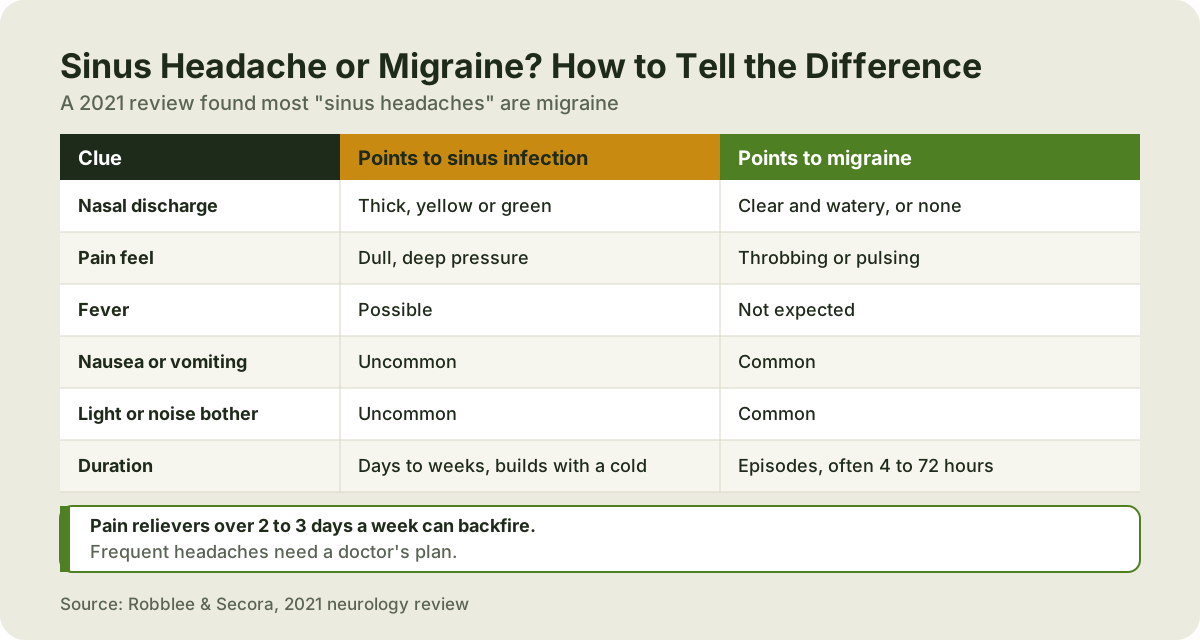
No single clue settles it, but the pattern of symptoms helps. Use this table as a starting point.
| Clue | Points toward a sinus infection | Points toward migraine |
|---|---|---|
| Nasal discharge | Thick, yellow or green | Clear and watery, or none |
| Pain feel | Dull, deep pressure | Throbbing or pulsing |
| Pain location | Both cheeks, forehead, between eyes | Often one side, but can be both |
| Fever | Possible | Not expected |
| Nausea or vomiting | Uncommon | Common |
| Light or noise bother | Uncommon | Common |
| Visual aura (zigzags, flashing spots) | No | Sometimes |
| Duration | Builds with a cold and lasts days to weeks | Episodes, often 4 to 72 hours |
| Past pattern | Tied to a recent cold | Repeats, runs in the family |
Some people have a mix. A stuffy nose and watery eyes can show up during a migraine, which is part of why it gets mistaken for allergies or sinus trouble. The 2021 review advises that anyone with facial pain or pressure plus sinus symptoms should be checked for migraine.
Do allergies cause headaches too?
Allergies can cause real congestion and facial pressure. When the nose swells shut, pressure builds and you feel it in the face and forehead. If the problem lines up with pollen seasons, a pet or dusty rooms, allergy is a good suspect. In New Jersey, that often means tree pollen in spring, grass in early summer and ragweed in late summer and fall. For the nose side of the story, see our guide to sinus pressure from allergies.
Allergies alone, though, do not rule out migraine. People with allergies can also have migraine. A 2024 review of headache myths in Regional Anesthesia & Pain Medicine lists sinus headache among common disorders that are often misunderstood, and it points to the International Classification of Headache Disorders as the standard for telling headaches apart.
What should you track before seeing a doctor?
A simple diary can make a visit far more useful. For two to four weeks, write down:
- The date and how long each headache lasted
- Where the pain was and what it felt like (throbbing, pressure, stabbing)
- Nose symptoms: color of mucus, congestion, sneezing, itchy eyes
- Other symptoms: nausea, light or noise bother, aura, fever
- Possible triggers: pollen days, weather swings, skipped meals, poor sleep, stress, alcohol
- Every pain reliever you took and how much
Weather swings are common triggers for many people, and New Jersey can go from warm to cold in a day in spring and fall. A diary shows whether your headaches follow the weather, your cycle, your sleep or your allergy season.
What can you do at home?
Start with the basics, matched to what the symptoms suggest.
If it looks like congestion or allergy
- Rinse the nose with saline made with distilled, boiled-and-cooled or sterile water.
- Use warm compresses on the face for comfort.
- Drink fluids and rest.
- Do not use decongestant nasal sprays for more than 3 days. Longer use can cause rebound stuffiness.
If it looks like migraine
- Rest in a dark, quiet room.
- Drink water and eat regular meals.
- Use a cool cloth on the forehead or neck.
- Take over-the-counter pain relievers early in an attack, as the label directs.
Watch out for overuse
Pain relievers taken on more than about 2 to 3 days a week can lead to rebound headaches. If you are reaching for them that often, that is a reason to get a proper diagnosis, not a reason to take more.
The 2021 review also notes that migraine medicines can serve as both a treatment and a diagnostic tool. That means a doctor may use your response to migraine-directed treatment as one more clue. This is a decision for a clinician, not something to try on your own.
When should you see a doctor?
Make an appointment if:
- You get "sinus headaches" often, such as several a month, and decongestants and antihistamines have not helped.
- Nose symptoms last more than 10 days without improving, or get better and then worse.
- You have a fever with thick discolored mucus and facial pain.
- You use pain relievers more than 2 to 3 days a week.
- Headaches are getting more frequent or more severe.
Get urgent or emergency care right away for:
- A sudden, severe headache unlike any you have had
- Headache with a stiff neck and fever
- Swelling, redness or pain around an eye, or a bulging eye
- Double vision or other vision changes that do not clear
- Confusion, trouble speaking, weakness or numbness on one side
- Headache after a head injury
A primary care doctor, allergist, ear-nose-throat doctor or neurologist can help sort out the cause. If you live in the Garden State, you can find allergy and sinus doctors in New Jersey who can check whether your nose, your allergies or migraine is behind the pain.
Common questions
Can a sinus headache actually be a migraine?
Yes. A 2021 neurology review concluded that most headaches called sinus headaches are migraine, and that sinus headache is not a true diagnosis. Migraine can cause face pressure, a stuffy nose and watery eyes, so it is easy to mistake for a sinus problem.
How do I know if my headache is from a sinus infection?
Clues include thick yellow or green discharge, a blocked nose, pain that worsens when bending forward, and sometimes fever. Symptoms lasting over 10 days, or improving then worsening, raise suspicion of infection. A doctor can confirm, because symptoms alone are not always reliable.
Does a headache with a runny nose mean it is not migraine?
No. Migraine can come with a stuffy or runny nose and watery eyes. Thick colored mucus and fever point more toward infection, while throbbing pain, nausea, and bother from light or noise point toward migraine. A symptom diary helps your doctor tell them apart.
When is a headache with sinus symptoms an emergency?
Seek emergency care for a sudden severe headache, headache with fever and a stiff neck, swelling or redness around an eye, vision changes, confusion, weakness, or a headache after a head injury. These signs can mean a serious problem and should not wait.
Sources
- Vestibular and auditory manifestations of migraine. Current opinion in neurology, 2022
- Debunking Myths: Sinus Headache. Current neurology and neuroscience reports, 2021
- Upper respiratory infections. The American journal of medicine, 2010
- Debunking myths in headache diagnosis for the pain practitioner. Regional anesthesia and pain medicine, 2024
Trusted resources
From our sister sites
Healthy NosesStuffy Nose With No Cold: Causes of Nonallergic RhinitisA stuffy nose with no cold can be nonallergic rhinitis. Learn the common triggers, how it differs from allergies, and when to see a doctor.Coastal SinusChronic Sinusitis: Symptoms, Causes and the 12-Week RuleChronic sinusitis means sinus symptoms lasting 12 weeks or more, plus proof of inflammation. Learn the symptoms, causes, tests and treatment options.Articles are for general information, not medical advice. See a doctor for symptoms that are severe, last more than 10 days, or keep coming back. Last updated November 15, 2026.